Origin Trip #56: Mababu, Tanzania- 2026
Direct Trade for Nearly Two Decades

First on the agenda for origin trip #56: Shawn met with our farmer partners in Mababu, Tanzania. You might recognize some familiar faces from over the years! We’re honored to have worked with the Mababu CCF for over 14 years. We’ve watched this group– who has always been led by the incomparable Mama Mpoki, who you might recognize from the front of our bars–evolve so much during that time, but what has remained constant is their savviness and sophistication, their care for their community, and their dedication to their craft of organic farming and superior post-harvest techniques.

At the beginning of Shawn’s first day in Mababu, everyone sat together in a circle and shared something that brought them joy in the past year. Some farmers shared about the improved structure of their homes, others about the education they’ve been able to afford for their children. But nearly everyone shared their gratitude for our partnership and we’d have to agree. Something special you don’t see in your typical Western meetings? Celebrating with singing and dancing! The energy was contagious and Shawn joined in, too!

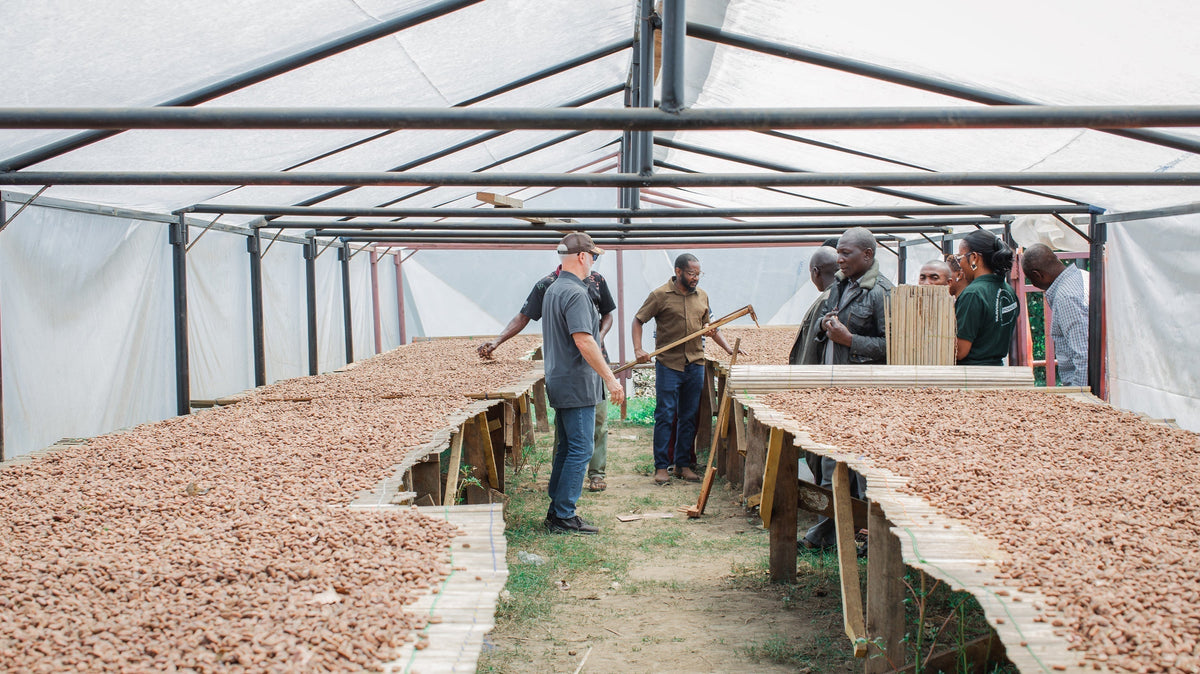
One of the best (& possibly most nerve-wracking!) parts of each origin trip has to be inspecting our next shipment of cocoa beans. This upcoming 15 metric ton shipment of cocoa beans–headed our way soon–aren’t just any ‘ol beans. These are Trinitario cocoa beans, grown on small farms (often less than a few hectares) by members of the Mababu CCF who match our exacting standards. We detail these standards in our contracts with all farmer groups, and adjust them periodically to ensure the absolute highest quality.

So it’s a good thing our farmer partners are experts at post-harvest and fermentation, both of which require a technical knowledge and an artful finesse. Before I inspect the beans themselves, I love to visit a few of our farmer partners’ shambas (Swahili for farm) and look at the trees, the pods, the shade, intercropping, and soil. We look at the health of their trees and discuss whether there are any disease, pest, or sustainability concerns.

Next, we head back to the central fermentary where I do a visual inspection of most bags, then remove random samples to inspect moisture and perform a cut test alongside the farmers. This is where beans are cut in half to have their color, size, shape, and moisture analyzed. We assess our findings from the day and discuss whether any tweaks need to be made for the upcoming harvest.

Next up on Origin Trip #56 to Tanzania: meeting with the students of the Empowered Girls & Enlightened Boys after-school programs we sponsor, along with our farmer partners in the village of Mababu. Currently, these programs boast 1,200 club members across 3 area schools. But in total, more than 11,000 students have graduated from these programs to date!
If you’ve followed us for long, or read the book my daughter, Lawren, & I wrote, Meaningful Work, then you know how important the work of Visioning is to our company. A Vision is a plan for the future, a path forward for an individual, or even an organization, like ours. And I credit Ari Weinzweig (co-founder of Zingerman's Deli) for his mentorship and friendship in helping us kick this off here in Tanzania over a decade ago. He is a noted author and expert on the topic of Visioning and we’re grateful for his guidance.

One of the challenging things for many people, especially those in under-resourced circumstances, is visualizing oneself at some point in the future while writing the narrative story of that moment as if it's happening in the present tense. This is a really difficult task (try for yourself & see, it takes some serious concentration)! This time, I met with a small group of the top ten students in the clubs and we focused on Visioning. Spur of the moment, I decided to try something different. Suffice it to say, it exceeded my hopes. We started with Agizo. He is sixteen and his vision, which he has worked on over the last couple of years, is to be an orthopedic surgeon! He is a straight-A student and his teachers say that he is brilliant. He's quiet and reserved but he agreed to try this experiment. I asked him to put his chair in the center of our circle. He said that he has been working on his vision for ten years into the future because that’s when he thinks he will complete his medical school education. I asked him to close his eyes and pick the place and time ten years into the future and he said that it was August 2036 and he vividly described working at a hospital in Dar es Salaam, operating on patients. I’ll save the details for another time, but impactful doesn’t even begin to cover it!
Afterwards, another student raised her hand and asked if we work on visioning with students in the United States and what that experience was like. While this is something we do as part of Chocolate University, we are not able to do this at the scale we would like. Her questions demonstrated that this is so powerful that students here in Tanzania are now challenging us to bring greater focus to this tool in the U.S. It left me feeling inspired to do more in our community with US students.

We've been bringing chocolate to farmers for nearly twenty years and today was no exception. In fact, for the first time ever I checked a bag (IYKYK) so that I could bring a chocolate bar for each farmer in the co-op. The entire Mababu CCF group was present for this meeting, and circled together to taste a variety of six different chocolate bars– many that we make with the same cocoa beans they grow, harvest, and ferment before shipping them across the globe to our factory in Springfield, MO.

Everyone loves comparing and contrasting the chocolate made with their beans versus the samples made with beans from our other origins; Ecuador and The Philippines. This is always fun, and gives great perspective for how even the same varietal can taste so different depending on the location, post-harvest techniques, and roasting profile. Last but not least, we presented the farmers with a banner recognizing our shared awards. The 70% Barrel-Aged Dark Chocolate Bar–made with their beans–won two awards in 2026: a Good Food Award, and a bronze medal from the Academy of Chocolate. Celebration ensued! These moments may seem small, but they’re meaningful. We call it Direct Trade, and we wouldn’t have it any other way.


At the end of this origin trip, and before I began my journey home, Chikoti and I made a visit to a potential new origin in northern Tanzania. We spent two rain-soaked days meeting with farmers there, who blew us away with their kindness, generosity and tenacity. I am still unsure whether this origin will work out but we walked away agreeing to purchase a few bags of beans to experiment with. It will be a very long-term project if it happens, as these farmers need a lot of partnership from us--and training from the Mababu Co-op--in order to meet our standards. But I was very heartened by the visit, and especially the people.